• Monday, May 28, 2012

Previous

Next

Starting a Tenure Box

August 4, 2011, 3:00 pm

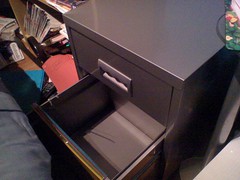
Filing Cabinet Open drawerAs a first-time tenure-track assistant professor, I’m already looking down the road to the different stages of tenure review. Academia has a number of different hurdles, often based on assessment of productivity over spans of years. So whether you’re in the same position as me, further down the line, or starting to think about the job market, it’s worth building good habits in personal archiving. While caught in the moment it’s easy to think that we’ll remember everything–but committees, teaching, service, publications and other work can add up fast.

What goes in your tenure dossier (or other portfolio) varies by university. Karen Kelsky has a good overview of the basics here. Before I started planning on what types of documents to save, I looked at the tenure dossier requirements for my area at a range of universities. Just because my department now doesn’t want a certain type of documentation doesn’t mean they won’t change their minds in the future–and thinking in universal terms is important in an era of continually shifting careers.

Before the fall semester becomes overwhelming, I’ve started my first tenure “box”–a digital archive of everything that might be essential down the line. Here are some of the thoughts that have guided me in getting started:

  • Too much is better than too little. As contract faculty last year, I was blissfully unaware that I should have been saving emails and letters that are now gone for good. Now, I save more documentation than I could possibly ever need to make sure I have specific details when the time comes. Will I include everything I put in the box? Not unless I hear a scale is involved in the tenure review. But it feels better to be over-prepared.
  • Invest in a document scanner. Even though a number of our most important files have moved to digital, there’s still plenty of things worth keeping in a physical tenure box, including letters, signed contracts, hand-written evaluations, and other hard to replace documents. But getting those files scanned in is essential to making them part of your records. For me, it’s a lot more likely to happen if I don’t have to leave the house to do it.
  • Don’t trust the cloud. My website already has a lot of the information I’d put in my dossier, but most of it is linked out to other sites. I don’t expect journal websites to go away or publications to delete their archives–but that’s exactly what happened to a journal I had an article in during graduate school. Never depend on another archive to keep the content that you might need in the future.
  • Redundancy is your friend. I just invested in a serious external hard drive (I recommend one with at least 500 gigabytes of storage and good ratings on long-term reliability) to act as the last line of defense in the event of a personal archive disaster. Other ProfHackers use SpiderOak and other cloud-storage systems in addition to local back-ups. Whatever your system, back-up storage only works if you use it. We all have horror stories about lost projects, papers, or irreplaceable photos.
  • Don’t wait til the ta-da nick of time. Nels Highberg wrote about approaching annual reviews with the mindset that they are fodder for the tenure dossier. As he pointed out, once a year isn’t often enough to be thinking about what you’ve accomplished. Memory fades fast. If your college or university has monthly opportunities for sharing accomplishments, take them seriously. They aren’t just opportunities to make your colleagues aware of what you’re up to–which is important on its own! They’re also a chance to be keeping track of those same events that you might forgot later.
  • Know what you’ve got. A big collection of files is great, but a group of files organized with consistent structure (and perhaps a continually updated index) is even better. Take a look at examples like online tenure portfolios (from Brian Croxall’s post on simplifying tenure) and physical dossiers, especially those produced by people up for tenure in your department. Keeping a list by area of focus (such as scholarship, teaching, and service) can also help you see any gaps while there’s still time to address them.

Do you keep a tenure box, portfolio or other personal archive? How do you keep up with your own record-keeping? Let us know in the comments.

Photo by Flickr user Vegansolider / Creative Commons licensed

This entry was posted in Productivity, Profession and tagged , , . Bookmark the permalink.

  • Print
  • Comment
  • digiwonk

    Excellent ideas! It’s amazing how fast all that stuff proliferates … then you can’t find it … or worse, you forget you even DID it (which didn’t seem possible just out of grad school, but a couple of years into the job, it happens all the time!).

    One thing I also do, in addition to the strategies you list, is to keep a document on my desktop called “Stuff I Did This Year” and every time I do something — a peer review, a TV interview, a guest lecture, a new committee assignment, an article published or submitted — I just add an item to the list. Then when I have to sit down to write up my annual report, I don’t have to REMEMBER what I did in January, or what was the name of the journal I did that review for. SOOOOOO much easier.

  • heathermwhitney

    My “Stuff I Did This Year” list is so valuable to me. Couldn’t live without it.

  • rightwingprofessor

    Much more important is to get your research done. If you have an outstanding CV showing a substantial publication record, a history of external funding, and good outside letters, you will get tenure even if your dossier is 1/4″ thick. Usually the people with dossiers filling multiple boxes are trying to cover up a weak record.

  • englishwlu

    This is a really useful post.  Everyone on a tenure track should keep these positive kinds of records.  They should also maintain a “shadow” tenure record, often held by a trusted tenured colleague/mentor, often outside the department.  The shadow tenure record logs the occasional weird remarks and odd events that might or might not be signs of something problematic–discriminatory, or retaliatory, or just plain uncollegial. Maybe some controversy about your position is prejudicing people–maybe expectations for tenure are a moving target–maybe you’re the victim of actual discrimination of the kind the EEOC would recognize.   It’s good to have an uninvolved (e.g. extra departmental) university friend who can hang onto the emails you forward them or send them to document what just happened.  Best version of these contain the offending or simply clueless colleague’s acknowledgment of whatever was said. In most cases these records can be deleted after the happy day of tenure, never even opened up or needed.  But if you should get into the zone of appealing a negative decision, you’ll be very glad that you kept a record, especially if everyone else in the university seems to have amnesia about what you remember!

  • http://ProfHacker.com George H. Williams

    That might be true at many schools, but it’s not true at every school. It’s best to familiarize oneself early with the tenure requirements at the institution where one is employed.

  • drnels

    Very true, George. At my school, teaching came first, and people with fantastic publication records and weak teaching were denied tenure all the time, sometimes thinking their publications would help when they didn’t.

  • http://twitter.com/ProfessorIsIn Karen Kelsky

    This is a wonderful post.  And thanks for linking to my post on tenure dossiers.  I really like your digital update—don’t trust the cloud!  Get a scanner!  Save emails!  I will definitely link to this post in mine, and recommend the two be read together.  Good luck with tenure!

  • http://twitter.com/overlobe Jeremy Yuille

    great thoughts: thanks!

    I’d add some helpful local software to the “Know what you’ve got” pile.. I recently had to trawl through the last 5 years of my digital archive of things to find details of timelines, outputs on projects etc.

    All stuff that I would have had nicely filed if I had developed the practice of the online portfolio you mention (thanks for that), but the upshot is that I didn’t have it, and had to find it. I’m 10 years in to my academic career, and my experience is that you don’t stop needing this kind of resource after you’ve got tenure..

    in this task, I found Leap http://www.ironicsoftware.com/leap/ invaluable.. it’s a fast and flexible file browser that augments the OSX finder – not sure of a PC equivalent sorry – I’ve also used things like DeovnThink in this capacity in the past too.

    Interestingly, another tool I used was Google Calendar – forensic searching for people, places etc when trying to find out “when was that paper?” and then narrowing down the search locally with file creation dates etc was super helpful.

  • http://twitter.com/AnaSalter Anastasia Salter

    Great suggestions, thanks! I’ve used Google Calendar that way too–it’s a good way to remember when a deadline was and thus when an important email or file might have been created. Leap looks awesome, makes me wish I used a Mac as a primary machine.

  • translog

    The importamce of documentation management is essential for tenure tracking. At the end of the service contract you cannot support your growth without these documents or email archives..

  • dmoser5

    Some great suggestions, to which I would only reiterate:

    If you have documentation that is ONLY in paper format, consider getting it scanned so you have digital copies to keep on that hard drive with all the electronic docs. It saved my ass last year when someone misplaced my entire review packet; fortunately, I’d scanned everything and was able to print it all out (yes, we are still paper-based; I have my own personal campaign to change that!).

  • http://twitter.com/KathrynTomasek Kathryn Tomasek

    Keeping a tenure file from the beginning was the best advice I received when I was starting out.  I’m impressed by how changing digital options for storage have affected things to consider–redundancy is probably the most significant here.  One thing that hasn’t changed is the importance of structure and knowing what you have where.  I’m reminded of having kept hard copies of dissertation chapters in my home freezer and having relied heavily on daily planners when going back to write annual self-evaluations.  
    Nels, digiwonk and others make excellent points about keeping track of all these things as you go along.  Much better to think of the annual evaluation as process rather than product, a way to check that you are on task and mark your progress throughout each academic year and thus throughout the years approaching the tenure review.  Ideally, by the time the latter approaches, you will have assembled the expected portfolio.

  • debtaub

    This is so useful to do!

  • http://twitter.com/cassandravb Cassandra Van Buren

    #UUtah built the Faculty Activity Report (FAR) system to help people systematically keep track of their meritorious scholarly activities https://faculty.utah.edu/activityreport/

  • tomwsanchez

    I think these systems are critical. Faculty should be tracking their activities on-line not only for themselves, but also for their departments, colleges, and universities. At re-accreditation time pulling faculty achievements together becomes much easier.  Students should be doing the same with e-portfolios.  Eventually, the two can be tied together for advising and tracking purposes.

  • http://micahvandegrift.wordpress.com Micah Vandegrift

    Love this post. Throwing my hat in the ring as a digital librarian, this is like info management 101 for folks like myself. To this already great list of ways to approach a tenure box, I’d add to seek out a motivated and competent librarian to help organize this stuff! I’m currently working on developing an institutional repository, which many other schools are exploring also, and that is a fantastic way to centralize, archive and organize your scholarly output. In fact some schools are even using the institutional repository as a digital tenure binder!

    I’m sure many readers already have personal systems like this set up, but if not I’m more than happy to do some virtual assistance if you’d like to explore some options for self-archiving. Find me about the web as micahvandegrift.

  • green_hornist

    Good advice to keep such a box, so you will have documentation when you need it.  But for god’s sake don’t send the whole box to the provost when you come up for tenure. Over my career, I have seen these tenure submissions spiral out of control, to the point where the big ones (literally arriving in laundry tubs) are genuinely counterproductive.  I made a concerted effort, both through persuasion and policy memos, at my institution last year, to stop the madness.

    A bloated laundry tub full or stuff–whether or not it accompanies a well constructed and much smaller dossier–just sends a message that the candidate cannot distinguish between what is central to the tenure case, and what is mere chaff.  I’m not kidding:  I have seen tenure candidates submit the minutes to all the department and committee meetings they ever attended, just to prove that they were in attendance!

    A tenure dossier should make a persuasive case (using solid evidence and reasoning) that the candidate has performed extremely well the duties and responsibilities of a tenure-track appointment.  No more, no less.  As one who annually has had the responsibility for making up or down recommendations, I can testify without a doubt that the best tenure cases were the most concise ones.  The bloated ones usually signaled that the candidate him or herself was doubtful about the strength of the case, and was trying to substitute quantity for quality.

    Pardon the analogy, but it is really akin to your annual tax return.  Yes, you keep all your papers and receipts in a box for tax time, but no, you do not send the whole box to the IRS.  You fill out the required forms, and if the tax people need more convincing, they audit you–at which time you may be glad you had a few extra receipts in your box to prove your point.

    When it’s tenure time, less is very often more.

  • http://twitter.com/AnaSalter Anastasia Salter

    Great points! I think thoroughness in archiving is important (although it would never have occurred to me to save something like the minutes to a meeting, that sounds a bit excessive) precisely so that material can be winnowed down to the most essential. At the same time, some of the more mundane items that won’t make it into a tenure case might be useful for an annual review, and something that isn’t important to one department might be essential to another.

  • http://twitter.com/AnaSalter Anastasia Salter

    That sounds like a really cool system–wish my university had something like that in place.

  • drnels

    This is another case where the Faculty Policy Manual comes in handy.  We are supposed to submit one tub with materials clearly organized in it.  As I learned when I went up, they go through that tub, too.  I wanted to submit some things digitally and was told they wanted hard copies in the tub.  And that’s what it’s called, “The Tub.”

    Less may be more, but let your Faculty Policy Manual Guidelines define what is less and what is more.

  • green_hornist

    That’s one Neanderthal administration!

    As a matter of fact, I’m working on a Faculty Handbook upgrade right now :)

  • drjeff

    > “serious external hard drive”

    PLEASE, people: don’t let a hard drive in your home or office be your only backup!

    While it will work fine to save you from malfunction or accidental deletion, think about what would happen if your computer becomes unusable or unavailable due to theft, fire, storm, electrical surge or something else like that (a friend of mine had a tree fall on his home office during a storm while he was out of town, and when he came back, everything in the room was ruined from water).

    If your hard drive is in the same room (or even the same building) with your computer, it’s EXTREMELY likely to get stolen or destroyed at the same time.  For anything as important as tenure documents, you simply MUST use an offsite backup.

    Mail your Mom or sister a CD or DVD you burned, once a quarter (set your calendar), for a dollar a pop.  Use SilverOak or Dropbox or Amazon CloudDrive or Microsoft SkyDrive or AVG LiveKive, or FTP stuff to your web server.  But make very sure you have a backup that won’t get destroyed at the same time as your primary files.

  • heathermwhitney

    Totally agreed. I’ve had external hard drives fail on me multiple times. 

  • http://twitter.com/carpeweb Jim Vernon

    Surprising or not, this serves as an important marker of the separation between teaching and credentialing.

  • swedenkistastellago

    I was caught by this news post on Facebook, and am now a subscriber to The Cronicle (free online). Thanks a lot, this made my day!

  • Feynman007

    Methinks the prof has taken too many pills. Using technology to enhance learning is one thing. Crass commercialization of teaching through for profit certificate mills is another. Stanford should sue the startup for stealing the course materials that the professor developed while he was on Stanford payroll.

  • http://www.facebook.com/people/Dragana-Dorothea-Zivkovic/1849549136 Dragana Dorothea Zivkovic

    The expanding virtual classroom and a departure to Wonderland. 

  • jaynicks

    “a camera, a pen and a napkin.”

  • nontraditional001

    Another online university, so what?  That’s innovative?  Maybe the low price will be innovative, but if there is no credential provided then why pay? It’s likely Prof. Thrun got 160,000 students worldwide to take his free online course because he was a Stanford professor. Good luck increasing the number after resigning. What about MITx?

  • http://twitter.com/GwenetteWriter Gwenette Writer

    Yes!  Democratize education! GO Sebastian!  GO David!

  • http://twitter.com/GwenetteWriter Gwenette Writer

    umm I think he had the crowds attention because of who he IS in the field & due to HUGE public demand for tech education at affordable prices & raging interest in AI. His qualities as an expert and a teacher will not be diminished at all by changing his address.

  • http://twitter.com/cragaro CC West

    Quite a humorous story.  As also a professor of computing science, I long since left the concept of a traditional lecture but remeained in the classroom as it is simply the best evironment for learning. Period.  There are SO many ways to make learning engaging in the classroom and obviously Mr. Thrun must have had some difficulties there to leave such a grand position in Standford.  Moving online will certainly increase one’s audience (especially if it’s free) but the question of student competence at the end of the online education is what will be suspect.  Obviously, if everyone could learn effectively online we would have no need for classrooms.  Yet in the this age of so many instant and varied forms of communications, my class enrollments remain strong.  It starts by creating an engaging and effective learning environment and with Mr. Thrun attempting to create such that is just as effective online as the rest of us do in the classroom, he may very well be producing “artificial intelligence” in those he educates.

  • http://twitter.com/GwenetteWriter Gwenette Writer

    The question is not how much money they will make, but what they will do with it and how transparently they will do it. If it supports the continued democratization of education, continued curriculum delivery development and student support/career services, this is a good thing.

  • http://twitter.com/GwenetteWriter Gwenette Writer

    umm I do not know the man, so I do not know if he “likes” money.  Do you know him?? To assume or imply this is a primarily profit motivated move may be a mistake.

  • http://twitter.com/SocialAcademic Kate

    As a sociologist who uses technology in the classroom, I think there’s a lot going on here. I’m disillusioned with the academy and think this is a brilliant idea. There are plenty of professors who still don’t take advantage of what technology can add to a classroom learning environment or who’ve forgotten that the point is teaching (none here of course). But I also think there are a lot of students for whom online courses alone don’t work– online courses require a great deal of self-discipline and focused time which can be problematic for many students. Moreover, these types of classes also require high speed internet access and other hardware that many lower income students may not have– many of my students still rely heavily on the college’s computer labs– so there’s some class issues involved here as well…

    I still think this is a great idea and the I would love to check out Thrun’s online class… 

  • marcalpv

    I took Prof. Thrun’s online course at Stanford and agree that he is a great teacher.  For those with interests in the outside world, an Academic career requires a fine balance between Town and Gown.
    In my experience, at different times in one’s life one is drawn to one or the other. The Medical Faculty seems able to give their Academic a wider choice. I think Stanford is currently the loser on Prof. Thrun’s departure. In time Prof. Thrun will also wish he could have continued to push back the frontiers of Research with a group at Stanford.

  • http://www.facebook.com/adamevans77 Adam Evans

    This is simply a step in the new direction of education. Those who oppose what these men are doing are the professors and university administrators who are afraid of an education that awards good teaching. The days of terrible professors that have no business teaching are numbered as students will be drawn to well-designed accredited degrees that are offered online.

  • tay192

    I honestly love stories like this–the breaking of academic chains.  My only regret is that it doesn’t include the humanities.  How nice it would be to have a vibrant humanities presence alongside technology!  

  • csgirl

    He is going to teach students who have never programmed before how to program a search engine in 7 weeks??? What is he going to do, give the students the code and tell them to type it in? I have been teaching introductory CS to students who have never programmed before for years. In 7 weeks, they typically can barely write a 20 line simple program.
    Maybe he assumes the students will spend  50 hours a week teaching themselves the principles of computer science? I just can’t imagine.

  • http://www.facebook.com/profile.php?id=1106772533 Rosa Ilinka McGill

    “I feel like there’s a red pill and a blue pill,” he said. “And you can
    take the blue pill and go back to your classroom and lecture your 20
    students. But I’ve taken the red pill, and I’ve seen Wonderland.” Love it!

  • czander

    Given
    the demand for secondary education (considered high school and junior college)
    India will need to increase the numbers to be educated from 17 million in 2008 to
    57 million in 2017. 
    In addition, India is attempting to achieve a university enrollment increase of
    30 per cent by 2020.  To meet these goals
    the traditional way (brick and mortar) would require the addition of 700 universities
    and 25,000 schools and junior colleges with an addition of more than a million
    teachers, 15,000 faculty with Ph.D.’s in management and over 30,000 Ph.D.’s in
    engineering (Pathak, 2011). They cannot and will not build institutions or hire
    thousands of professors that they do not have, instead they will use electronic
    means to deliver the needed education. As of July 2011 there were 3,500 MBA
    programs in India and their numbers are increasing at a rapid pace.

    Consider one method they will use. NPTEL is a joint venture by Indian Institution of
    Technology and Indian Institute of Science established to deliver education in
    engineering throughout the country using curriculum-based video and web
    courses. This allows a single experienced professor to reach thousands of
    students. Each course contains materials that can be covered in depth in 40 or
    more lecture hours. In addition, 110 courses have been developed in video
    format, with each course comprising approximately 40 or more one-hour lectures.
    Students have access to 129 web courses in engineering/science and humanities,
    and these offerings will continue to grow.

  • martypjw

    There’s something I don’t understand about courses like this with huge enrollments.  I can see how you could deliver great, stimulating material to the students and design interesting, valuable assignments, but surely there’s no way for the instructor to give them meaningful individualized feedback?  That seems to me to be a crucial component of good teaching….  Can anyone who has been involved in courses like this shed some light on this issue?

  • http://twitter.com/halmbaprof Halima Ozimova

    MayBeThisTenuredProfessorDepartsStanfordU4 RussianSiliconValley?Did HeBegin2StudyRussian?Discus’@ 
    http://www.couchsurfing.org/group_read.html?gid=2164&post=10938064

  • squacky

    Geez. That was a comical observation. Should have been obvious given that I said I was like him in that regard. 

  • squacky

    These are empirical assumptions. Big ones. I hope you’re right. But, we have to wait and see. 

  • nontraditional001

    What does “democratized education” mean? 

  • http://www.facebook.com/nolan.bill Hercules T. Thundergasp

    All in?

  • robodude

    But this statement violates the basic premise of most universities: course materials are the property of the professor, not the institution. Would the poster suggest Stanford also sue Prof. Thrun if he moved to MIT to teach the class?? Certainly not, I would hope! It is rather ironic that Feynman007 is suggesting Thrun is guilty of “crass commercialization” while asserting that traditional “rules of commericialization” should apply to educational institutions whose main goal is to disseminate knowledge, not lock it up. Although I value the lecture format and the more personal methods of traditional pedagogy, I agree with touchingthestone that Stanford should jump onboard to use Thrun’s talents (as they have in the past). 

  • happyprof

    No surprise here- Stanford can provide only so much to reward someone doing something innovative, but what he may be underestimating is the prestige value that being associated with Stanford added to the appeal of his course. 

    Secondly, I would not worry about these ventures replacing high-quality classroom instruction.  Problem number one: 500,000 students can’t email him for advice, help, mentoring, encouragement, letters of recommendation, and other real world things that good professors offer. 

  • 12009444

    Professor Thrun is no novice and he has connections with Google. Check out udacity.com. This is an exciting development in online education and should add nicely to the Khan Academy and similar start-ups.

  • bmcdeepak

    Welcome to Bubble 2.0!

  • PeterCaoPeterCao

    Though Sebastian Thrun had made professional achievements at Stanford, he had troubled himself into a number of criminal cases originated from a campus atrocity case in 2004. Many innocent people had been influenced in fighting against those crimes since then, and Thrun’s name is not clear in those cases.
    Proof of real names, dates, photos along with a police case number are listed in my blog link [ http://tysurl.com/BsEnQ4 ] Wish all victims molested in those cases would walk out of influences out of them sooner or later; and also wish those cases could be clarified and have criminals who committed those anti-humanity crimes concurred eventually.

  • http://twitter.com/Cr1ky Irfan Ali-Khan

    Fantastic! I love the way education is moving online, it makes it so much more fun! Go Sebastian Thrun!

  • archman

    It is possible that tests and other ways for the students to be assessed in their skills are missing from the “camera, pen, and napkin” methodology. That would be very, very bad.

  • steveatryokan

    We’ve had interactive/collaboration online learning since 2000 that features synchronus and asynchronous in small cohorts.  Why?  Because BF Skinner thought education could be done by television in the 1950s and failed (i.e., Just because one improves the mousetrap does not make dumber mice”).  All the bells and whistles of the internet media still lack the one basic component of a complete education: interaction between instructor and student because not all students are alike or learn in similar fashion; many need special insights and attention that can only be offered by a live instructor.  So, yes, the new mode of education will speed and modify instructional techniques, but it has not been updated to provide the human interaction necessary.

  • Socratease2

    It took 300 years for Rome to fall, but it fell. Don’t mistake the pace of change for its inevitability. And the pace is already picking up, the traditional university classroom, no matter what its relative merits and demerits are, is simply going to go away. Anyone out there still use the telegraph, a slide rule, a typewriter. As usual, the entrenched interests and the over 50 crowd are going dig in their heels and decry the changes in higher education, but change begets change and on it goes.

  • ychumanities

    I’d like to see how his classes run.  While I suppose it might be possible for 100,000 students to work on computer programs online and get feedback on whether their constructs work or not via some automated system, I can’t quite see how that would translate to evaluating the type of critical analysis expected in cinema studies.  How would you provide feedback on 100,000 essays?

  • happyprof

    PeterCao, some Google searches regarding any wrongdoing by Thrun, scandals, etc, come up with nothing.  Please don’t waste our time with libelous claims. 

  • markcarnes

    Easy.  Cash the check.

  • sambarber

    Why pay money for an online course? You can buy the book yourself and study the material.  “Courses” are needed for more than the textbook: the building of interpersonal relationships with peers and professors, the collegiality of networking *gasp!* face-to-face with others, the proof (yes, proof) that tests (evaluations) were taken honestly and in a time frame that can be compared to others to establish a standard.  The professional world does not take online degrees seriously, nor should it.

  • eye_no_better_than_u

    Wow, he must be one extraordinary teacher that none of his 160,000 students needed to ask a question, review their approach to the homework or project, or even seek reassurance.  Just how much individual feedback does a student get in a class of 500,000?  I cannot see this approach working even in the most trivial mathematics course, even one with some sort of automatic web-based homework system such as WeBWoRK or WebAssign.  A real course, as I see it, involves both real (as in individualized and broad) feedback and real, meaningful assessment.  It would appear that Professor Thrun’s students will create some sort of database project that either runs or does not run, and that the assessment of that project will be left to whoever wants to do an assessment of the student.  In that sense, it seems to me that what Professor Thrun is offering is an updated version of the textbook, not an updated version of the classroom.

  • davidfalcone

    During the era when universities were born, “eating with a fork and spoon was the most
    effective way to eat. We had the industrialization, we had the invention of celluloid, of digitial media, and, miraculously, people today eat exactly the same way they ate a thousand years
    ago,” he said.

    I wonder why they do that?

  • westerndaoist

    Great for data-driven, “how to” courses, probably not for the subtleties of philosophical thought, music, art and literature.  But that, too, may be just around the corner! It will be interesting to follow the development of Extreme Virtual Learning and see how–if at all–feedback and assessment play into it.

  • westerndaoist

    Great for data-driven, “how to” courses, probably not for the subtleties of philosophical thought, music, art and literature.  But that, too, may be just around the corner! It will be interesting to follow the development of Extreme Virtual Learning and see how–if at all–feedback and assessment play into it.

  • westerndaoist

    Great for data-driven, “how to” courses, probably not for the subtleties
    of philosophical thought, music, art and literature.  But that, too,
    may be just around the corner! It will be interesting to follow the
    development of Extreme Virtual Learning and see how–if at all–feedback
    and assessment play into it.

  • http://savvides.info Philippos S

    I took the AI class as well and learned a lot. It was actually better than other traditional courses I had.

  • http://profiles.google.com/lecturerrich Richard Egan

    Actually, maybe not – some universities, especially Research U, tend to have strong IP protection but through agreements with the Faculty councils and the like give copyright ownership to the Professor.  If that is the arrangement at Sanford it is his to do what he likes.

  • Charles Martel

    This course “recreates the intimacy of one-on-one tutoring” in the same way that watching porn online recreates the intimacy of having a girlfriend.

  • concerndcitizen

    The best professors will become rich, while the mediocre ones will become impoverished — in fact which undergrad even gets the professor to teach, it’s mainly TA’s anyway.  Who would willingly learn from a mediocre teacher when greatness is online and free.  I hear a giant sucking sound coming from the universities.

  • http://twitter.com/HF_Tunisia Hamdi Frères Tunisia

    #Tunisia

  • 22028784

    This article does not describe anything new. You could teach a course to millions with instructional television in the 60s. How does he evaluate a student’s work and confirm the student’s identity? There is more to this story that needs to be told. That is where the innovation has been lacking. It is even a problem in classroom instruction but less of one.

  • 22028784

    This article does not describe anything new. You could teach a course to millions with instructional television in the 60s. How does he evaluate a student’s work and confirm the student’s identity? There is more to this story that needs to be told. That is where the innovation has been lacking. It is even a problem in classroom instruction but less of one.

  • http://www.facebook.com/adamevans77 Adam Evans

    Evidence. That makes me laugh. You have no evidence to prove your point either, yet you ask it from me for something that is obvious to all. 

  • http://www.facebook.com/profile.php?id=1122196715 Susan Martin Robbins

    The future of education…

  • http://www.facebook.com/profile.php?id=1122196715 Susan Martin Robbins

    It depends on the university and their explicit policies as to who “owns” course materials for online courses. I have taught several online courses for the past 15+ years and my university owns the materials that I use online unless they have been previously copyrighted by me.     

  • http://www.facebook.com/profile.php?id=299901116 Sue McGilloway

    Contrary to the comment regarding the lack of cognitive development within online learning, I propose that individuals who persist and take advantage of the opportunities available in online learning actually support cognitive development as well as self-discipline. I have done my entire master’s program in an online environment and have grown  in my ability to synthesize, analyze, and evaluate research. The opportunity to return to video lectures as well as instructor and student insight reflected in posts has enhanced my integration of class content. Presentation of online coursework is a cost effective method of delivery that encourages individuals with demanding work and family obligations to obtain an education.

  • jeltez42

    There are those who believe grades from tests and homework are worthless as an intelligence/compentency indicator and you should only be judged on your demonstrated abilities.  It is one thing to say I took a class on creating a search engine and got an A, but it is another to say to an employer, ’here is my search engine and here is how it works’.  The employer will then get to judge if it “works” or not as well as if you actually created the work yourself by asking you questions about it.

    The work world seems to be slowly moving away from obessing on grades and transcripts and putting focus on exactly what can you do for me an prove it by showing me and answering my questions. 

    To better phrase your concern, the question that deserves to be asked is ‘How do you mentor and give help to a million students at one time?’  Or are they just going to be left to their own devices?  If left to their own devices, then it is no different than going to a library and reading a book on the subject, which is not a bad thing.  Then there is no need to worry about evaluating student work, test scores, nor does it matter about confirming identity.  You will solely be judged on demonstrating your abilities.

    Ben Franklin was a strong advocate of self-taught education but also included that you needed learned mentors to help guide you in your studies and to keep you grounded in reality.

  • http://www.facebook.com/linary.kingdon Linary Wigg Kingdon

    ….Interesting….

  • johngraulty

    The academy does SO many things that are a thousand years old!

  • lchaim

    A faculty member at Stanford does research, and gets grants, or s/he does not get tenure.  There is no such thing as a “tenured teaching position” at a major university. Teaching is not a major activity of STEM faculty at big universities, getting grant money is what is important.    Do you mean that he is now paid on a grant, and doesn’t have to teach anymore?

     Get your facts straight, people!  How can you provide useful advice, or interesting news items, if you don’t even know how universities are organized?  

    Also, if the guy is/was/ kind of still is/ a Stanford faculty member, he has the terminal degree in his field, which would mean that he is not a “Mr.”  

  • The Chronicle of Higher Education
  • 1255 Twenty-Third St, N.W.
  • Washington, D.C. 20037